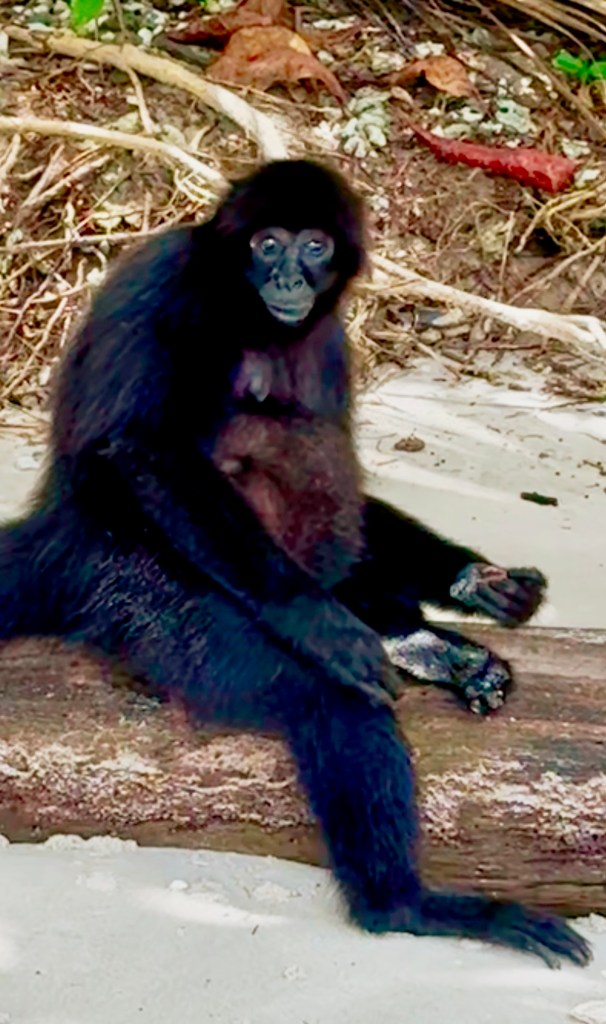
When Oleta was docked at Panamarina, a short dinghy ride through the mangroves brought us to Linton Bay—and to Monkey Island. Once home to a troop of howler monkeys, only one remains today. Cruisers sometimes stop by with food and water, while the locals mostly keep their distance.
Two of our cruising friends have both held her. A long time ago, the monkey bit one friend when she tried to stand up after holding her. More recently, another friend has held the monkey several times in her lap with no issues at all.
I had yet to visit the island, and I wasn’t sure what I would do. While I was away in the States for several weeks, Eric went to the island a few times with our friend and some others. He saw her being held, seemingly friendly with everyone—accepting head scratches, drinking water, and eating bananas. One day, the monkey even climbed down from our friend’s lap and hugged Eric’s leg while he was standing.
Eric was eager to take me to see the monkey once we got back from Colombia, but the weather kept us away. He didn’t recall the biting story, and I still wasn’t sure what I’d do if she approached me—so I didn’t rush the meeting.

Finally, with the sun shining and a cool breeze, we stopped at Monkey Island after our fruit and veggie run. We pulled the dinghy onto the shore and started calling: “Hey mama monkey, hey mama, we have a banana for you…”
For several minutes, nothing. I wandered down the beach, my bare feet leaving imprints in the wet sand as I studied shells. Then I saw her—emerging from the thick jungle leaves, trotting down a small hill toward us. I stayed where I was while she climbed onto the low trunk of a tree, twitching her head and squeaking.
Eric and I were separated by the tree—he on one side, me on the other. I held out a piece of banana, but the monkey only looked from Eric to me. Thinking she needed us closer together, I joined Eric, and we sat down on a large log embedded in the sand.
As soon as we did, she lumbered down the tree, onto the log, and—before I could process what was happening—into my lap. Eric immediately stood up, leaving me alone on the log. She wrapped one arm around my chest and settled against my side, her head pressed right at my ear. Each time she squeaked, I felt the vibrations.
I stayed still, staring straight ahead, minimizing every movement. Soon she shifted fully into my lap, her arms draped loosely over my shoulders, legs snug around my waist, and her tail wrapped tightly around my leg. The banana in my hand was forgotten, squished gently between us. What she wanted wasn’t food—it was contact.
To say I was uncomfortable is an understatement. In my head, I kept repeating: “I am calm. Everything is okay.” I thought of Jane Goodall and tried to channel her energy. As a kid, I was captivated by Gorillas in the Mist and by any documentary on her. Years ago, Eric and I even went to see her speak in Austin.
But in that moment, I didn’t feel like Jane Goodall at all. I felt afraid—afraid of what might happen if I moved wrong, afraid of her twitching head and unpredictable squeaks. She clearly has health issues. Maybe after more time, I could relax into it, but this was my very first encounter, and it happened so fast.
Eric gently offered her a piece of a banana. She ate it, but I noticed blood on the fruit—a sign of scurvy. When she finished, she wrapped herself around me again. Eric moved slowly, checking on me, but I did not want to rush her, so I just sat there, breathing.
Eventually, she loosened her grip and tested the log with one foot. It gave me enough space to quietly stand up. I walked back to the dinghy, grabbed my phone, and filmed a short snippet of her as she ate the squished banana. Then we left her on the beach and headed back to Oleta.
Even though I wasn’t completely calm, I felt strangely grounded—like I’d brushed up against something beyond myself. The whole experience feels surreal. Once she came down from the tree, she was in my lap before I knew it—like a grown child needing comfort. My instinct was clear: stay calm, move slowly, don’t provoke. Looking back, I wish I’d been braver, but I also know I did the best I could.
Later, as I replayed the day in my head, two things nagged at me: the twitching of her head, and…well, the unmistakable “dangly bits” I saw when she jumped back on the tree. For as long as anyone can remember, the monkey has been called “she.” But after some Googling (and asking ChatGPT, since Google wasn’t much help), I’m 99.9% sure she is actually he. Not that being male makes him more dangerous, but it definitely shifts the whole “momma monkey” story I thought I was living.
I also asked about his twitching head and bleeding gums. The answers pointed to possible neurological disorders and nutritional deficiencies. That broke my heart. He needs more than bananas and water—he needs a community.
This was my first real encounter with him, and now I’m left with the question: what, if anything, should I do? I told Eric I wished we could safely take him to Francine’s sanctuary in Bocas del Toro. He admitted he’d thought the same, but it would be too dangerous.
Cruisers are the only ones who stop by, bringing food and occasional companionship. But is intervening really helping—or could it hurt? What if reporting him led to his relocation or worse? Eric and I have talked about this before: the way light and shadow always coexist—peace and war, health and sickness, floods and renewal. Sitting with it all, not labeling it as good or bad, but simply what is.
This encounter is still sitting with me. Maybe the question isn’t always what can I do, but how can I be with it?


 Soulful Mermaid
Leave a reply to Jill Kury Cancel reply